
How to Palpate Your Horse’s Muscles – Why It Matters and How to Use a Massage Gun Safely
Regularly palpating your horse’s muscles is a valuable tool for detecting tension, soreness, or early signs of injury. It helps you understand how your horse feels physically and can improve your partnership and performance together.
Why Palpate the Muscles?
Just like athletes, horses can experience muscle fatigue, tension, or compensation due to training, tack, or asymmetry. By regularly feeling through your horse, you learn to recognize:
- What the muscles feel like when they are soft and elastic
- Where your horse typically holds tension
- When something feels different than usual
This allows you to adjust training or rest as needed, or seek help from a veterinarian or equine therapist before problems worsen.
How to Do It
Start with your hands
Use your hands and fingertips to methodically go over your horse’s body. Start at the neck and work your way back over the shoulders, back, loin, and hindquarters. Apply light to medium pressure – similar to pressing into a ripe avocado.
Feel for:
- Are the muscles symmetrical?
- Are there any tense, hard, or reactive areas?
- Is any area unusually warm or cold?
- Does the horse react with ears, tail, or steps away?
Observe and document
Take notes or photos to track changes over time.
Massage Guns – A Tool for Relaxation
Massage guns have become popular for both humans and animals to help loosen muscles and increase circulation. When used correctly, they can be a great supplement to help your horse relax and recover.
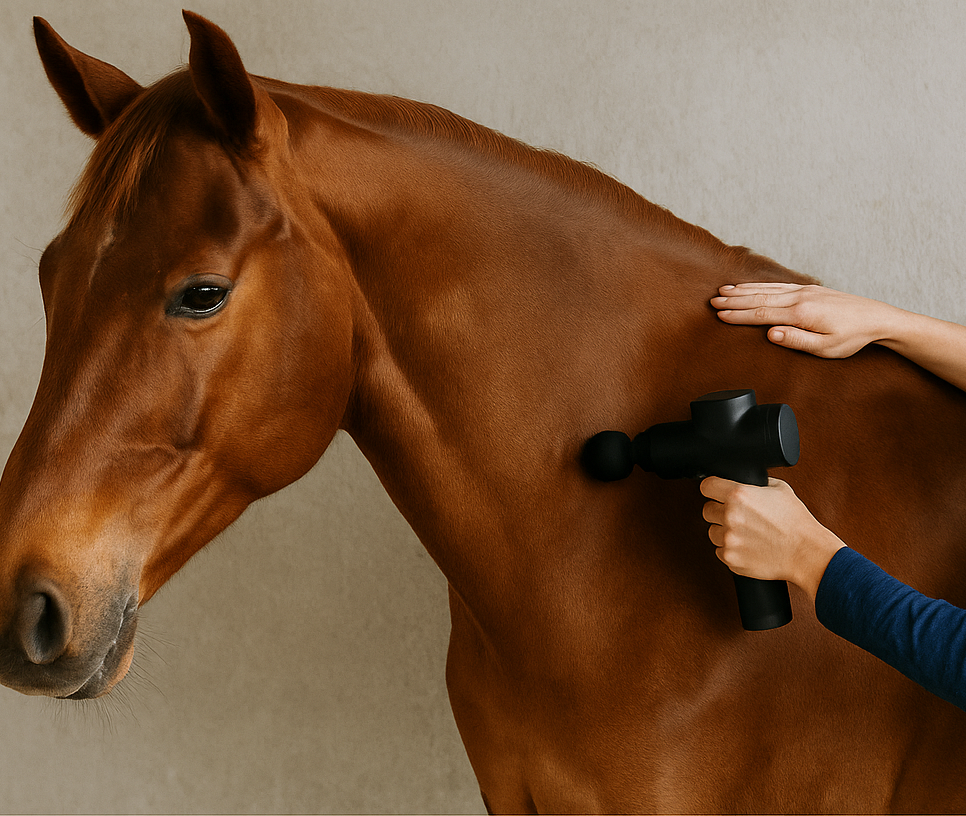
Benefits of using a massage gun on horses:
- Improves blood flow in the muscles
- Helps release muscle tension
- Can increase mobility and reduce stiffness
- Most horses find it pleasant
How to Get Your Horse Used to the Massage Gun
Some horses may be sensitive to the vibration or sound of a massage gun. A gentle way to introduce it is by starting at the withers, an area where many horses are less sensitive and often enjoy touch.
Try this approach:
- Place one hand gently on your horse’s withers.
- Use the massage gun on your own forearm or hand, allowing the vibration to transfer through to the horse in a soft and indirect way.
- Once the horse is relaxed, slowly move the massage gun directly to an area where the horse clearly enjoys it, and then continue to the muscles you wish to treat.
- Pay attention to the horse’s reactions and stop if it shows discomfort.
Important Guidelines:
- Use on large muscle groups: Shoulders, sides of the neck, the long back muscles (not directly on the spine), croup, and hindquarters.
- Avoid bony areas: Never use the massage gun directly over bones, joints, the spine, shoulder blades, or hip bones.
- Adjust speed and pressure: Start on low speed with gentle pressure.
- Keep sessions short: Limit to 30–60 seconds per area, with breaks in between.
Summary
Regular muscle palpation is a simple and effective way to monitor your horse’s physical well-being. A massage gun can be a great addition, but use it wisely and always let your horse’s reactions guide you.
By gradually introducing the massage gun – starting at the withers and using your own arm as a buffer – you build trust and create a positive experience for your horse.
Remember: When in doubt, consult with an equine therapist, veterinarian, or another equine professional.